
Visual acuity & magnification requirements
What is visual acuity?
What affects visual acuity?
How is visual acuity determined?
To correct refractive errors, ophthalmologists and opticians determine the visual acuity with correctors (Latin: visus cum correctione) – that is, visual acuity with the best possible correction. Various standardised visual acuity charts are available for determining visual acuity:
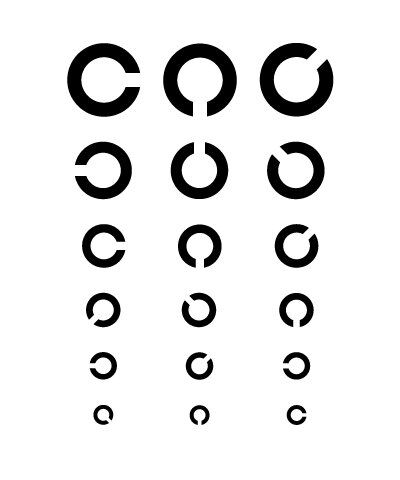
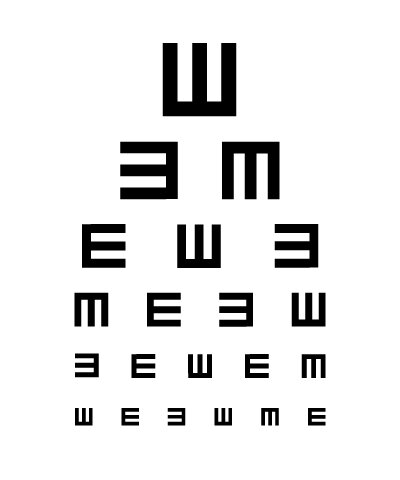
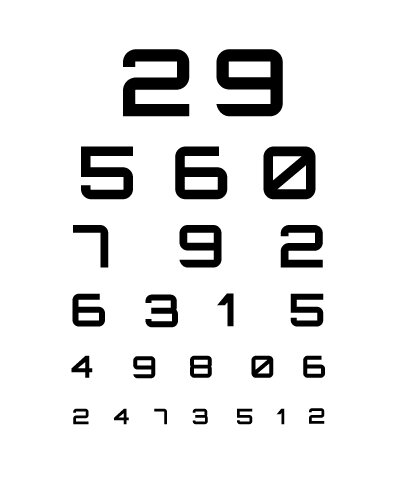
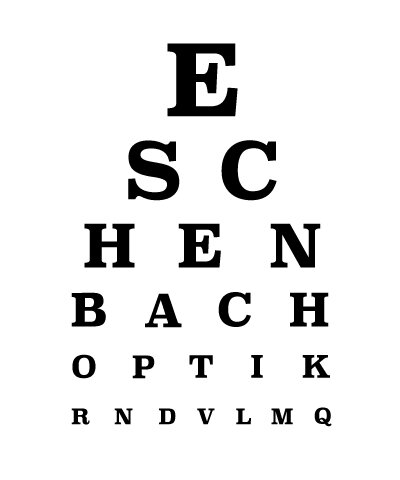
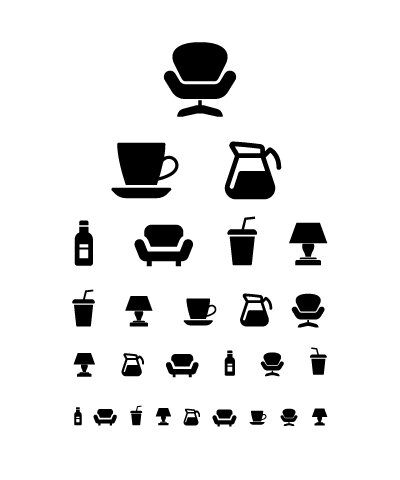
Although these charts differ in shape and appearance, they have one crucial feature in common: they are displayed at a specified viewing distance using eye charts or optotype projectors. The optotypes’ proportions are designed so that their size is always five times their line width – and, in the case of the Landolt ring, also five times the width of the gap in the ring.
If, during visual acuity testing, you can just about make out an optotype whose line width appears to you to be less than one minute of arc, this corresponds to a visual acuity of 1. With a visual acuity of just 0.5, the optotype must be twice the size to be recognised.
When glasses are no longer sufficient
If visual acuity is no longer sufficient despite optimal correction (visual acuity with correctors), the decline in visual acuity can be compensated for by enlarging the retinal images. The magnification requirement describes how much magnification is needed. This is calculated as follows:
magnification requirement = required visual acuity / visual acuity with correctors
The required visual acuity depends on the specific viewing task and can vary greatly:
| Required visual acuity | Vision task |
| Visual acuity 0,8 | Reading travel timetables |
| Visual acuity 0,7 | Reading a telephone directory |
| Visual acuity 0,5 | Reading the newspaper |
| Visual acuity 0,4 | Watching television |
| Visual acuity 0,1 | Orientation outdoors |
the visual acuity required depends on the specific viewing task. This also means that different vision aids are often needed for different viewing tasks. In addition to the magnification itself, environmental conditions also play an important role: good, high-contrast lighting can significantly improve visual performance – and reduce the magnification requirement. Many of our magnifying vision aids are therefore equipped with modern LED technology, ensuring better visual comfort through powerful and even illumination.
The right vision aid for every task
Eschenbach Optik’s extensive range offers you a wide selection of magnifying vision aids, optimised for a wide variety of viewing tasks.
Seek detailed advice from your optician to find the best solution for your requirements and needs – or discover our product guide right here.