
When our eyes age
What is presbyopia?
As we get older, our bodies’ capabilities begin to decline. This also applies to our eyes. We reach the peak of our visual performance as early as our teenage years. After that, the elasticity of the eye’s lens gradually decreases. However, this only becomes noticeable from the age of 40: small print and fine details become increasingly difficult to make out, even when you move closer. Letters can often only be read if books, newspapers or magazines are held far away from the eye – but then they often appear too small to be recognised comfortably.

How presbyopia occurs
A young lens is very elastic and can therefore change shape easily. This ensures that we can focus on both nearby and distant objects and thus see clearly. This ability is also known as accommodation. As this ability diminishes, what is referred to as the near point moves further and further away – that is, the point at which we can still see clearly at the closest distance.
How can presbyopia be treated?
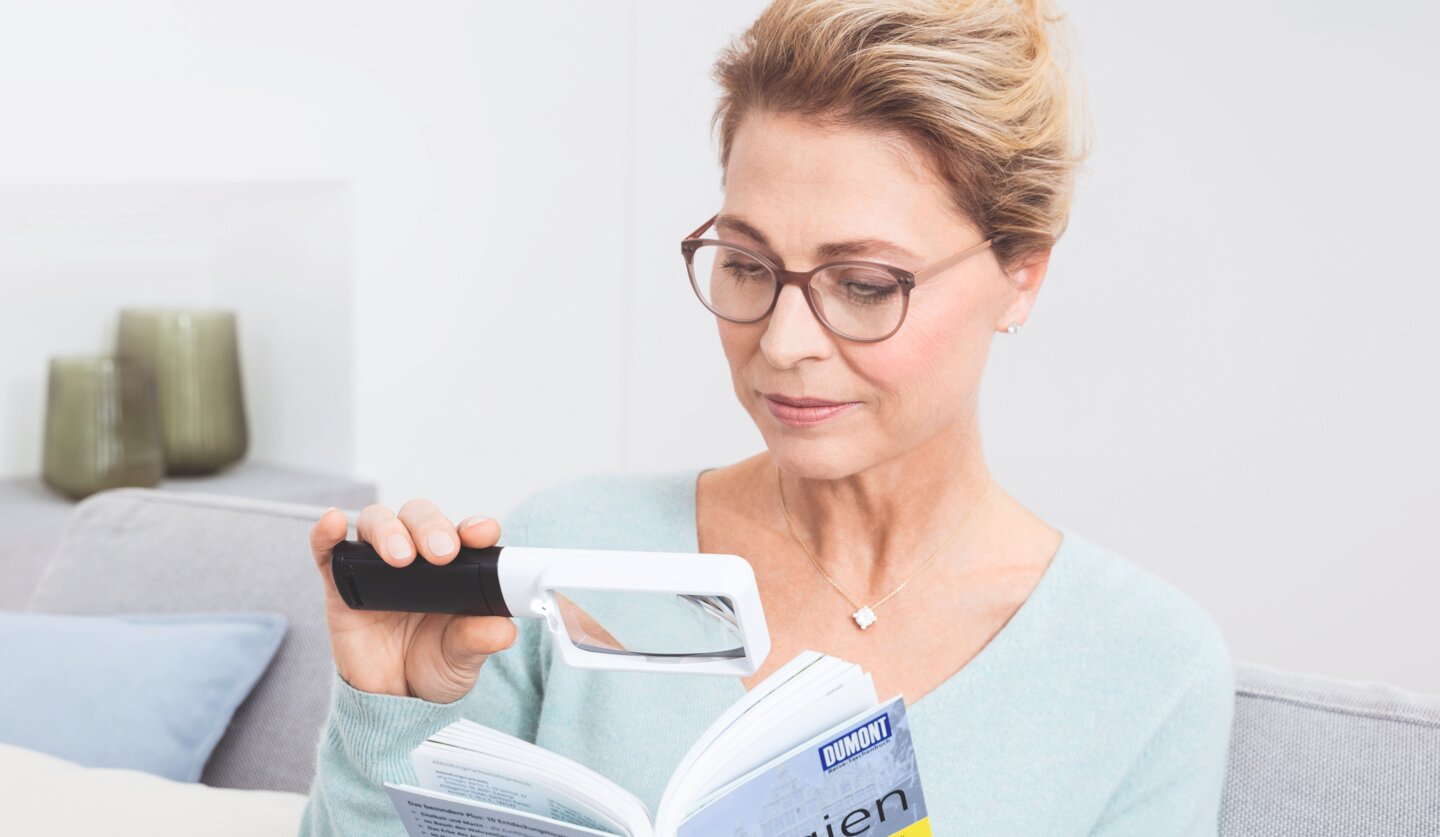
As the ability to accommodate changes differently in every person, it is advisable to have your eyes checked regularly by a specialist from the age of 40 onwards. Reading glasses can effectively compensate for presbyopia in the early stages. But magnifiers – usually fitted with powerful lighting – also make everyday life considerably easier for those with presbyopia and can help you maintain your usual quality of life.

Why is an illuminated magnifier extremely helpful?
As we age, our eyes’ need for light increases. For example, a 60-year-old needs around 15 times more light than a 10-year-old to achieve the same impression of brightness. Hence reading glasses are often insufficient, particularly for the over-50s, to enable them to make out small print or fine details. We recommend using magnifiers with powerful lighting, especially in poor lighting conditions. We offer a wide range of magnifying vision aids for various applications.